The Economics of Traditional NFTs
Traditional NFT implementations on Solana store all metadata on-chain in individual accounts. Each NFT requires approximately 4KB of storage, costing around 0.012 SOL per mint. For a 10,000 NFT collection, this translates to 120 SOL in storage costs alone—economically prohibitive for many use cases.
This cost structure makes certain applications impossible: gaming items, social media tokens, loyalty points, and ticketing systems all require minting at scale. State compression fundamentally changes this equation.
The Merkle Tree Architecture
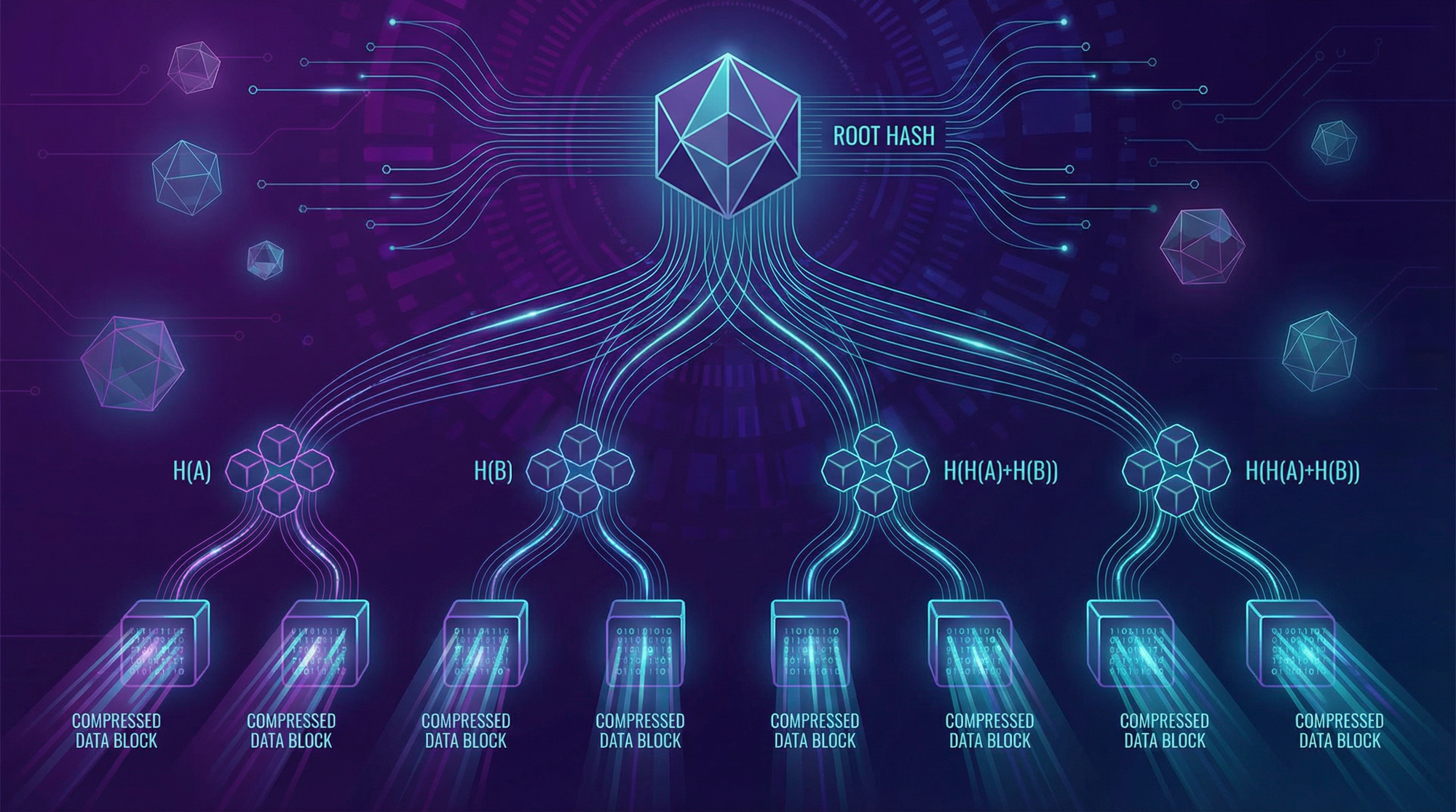
State compression leverages concurrent Merkle trees to store asset data. Instead of maintaining individual accounts, the system stores only the tree's root hash on-chain. Each leaf node represents an NFT, with its data stored off-chain by RPC providers.
When proving ownership or transferring an asset, clients provide the Merkle proof—a logarithmic path from leaf to root. The on-chain program verifies this proof against the stored root hash, ensuring cryptographic integrity without storing full data.
The tree depth determines capacity: a depth-20 tree supports over 1 million NFTs. The buffer size controls transaction throughput, allowing multiple concurrent updates. This design trades off between capacity, cost, and parallelism.
Cost Reduction Analysis
The compression advantage scales exponentially with collection size. Minting 1 million compressed NFTs costs approximately 50 SOL compared to 12,000 SOL for traditional NFTs—a 240x reduction. Per-asset costs drop to around $0.0005, making micro-transactions economically viable.
This cost structure enables new business models: free-to-play games can issue unlimited in-game items, social platforms can tokenize every interaction, and enterprises can track physical assets without per-unit economics concerns.
Implementation Trade-offs
Compressed NFTs require RPC provider infrastructure to index and serve off-chain data. Users depend on these providers maintaining historical state. While the on-chain root guarantees data integrity, accessing that data requires trusted infrastructure—a departure from pure on-chain storage.
Client-side complexity increases: applications must construct and verify Merkle proofs for every operation. Wallet integration requires specialized support beyond standard token programs. Development tooling, while improving, remains less mature than traditional NFT infrastructure.
The concurrent tree architecture limits parallelism to the buffer size. High-throughput applications must carefully configure tree parameters and potentially shard across multiple trees. These configuration decisions impact long-term scalability and cannot be changed post-deployment.
Production Use Cases
Gaming studios are leveraging compression for in-game asset economies. Star Atlas issues compressed ship components and resources, enabling complex crafting systems without prohibitive costs. Players trade millions of items with negligible blockchain overhead.
Social platforms use compressed tokens for engagement rewards. Dialect distributes badges and achievements to users, with total distribution costs measured in dollars rather than thousands. This economics makes decentralized social media viable.
Enterprise blockchain initiatives adopt compression for supply chain tracking and credential systems. Each physical item or certification becomes a compressed NFT, with verification remaining on-chain while detailed metadata lives off-chain. The cost structure finally matches enterprise scale requirements.
The Architecture That Scales
State compression demonstrates Solana's architectural flexibility. By separating verification from storage, the system maintains security guarantees while dramatically reducing costs. This design choice—trading some decentralization for economic viability—reflects pragmatic blockchain engineering.
The technology's success validates a broader principle: blockchain infrastructure must adapt to application requirements rather than forcing applications into restrictive cost models. State compression makes Solana viable for use cases previously impossible on any blockchain.