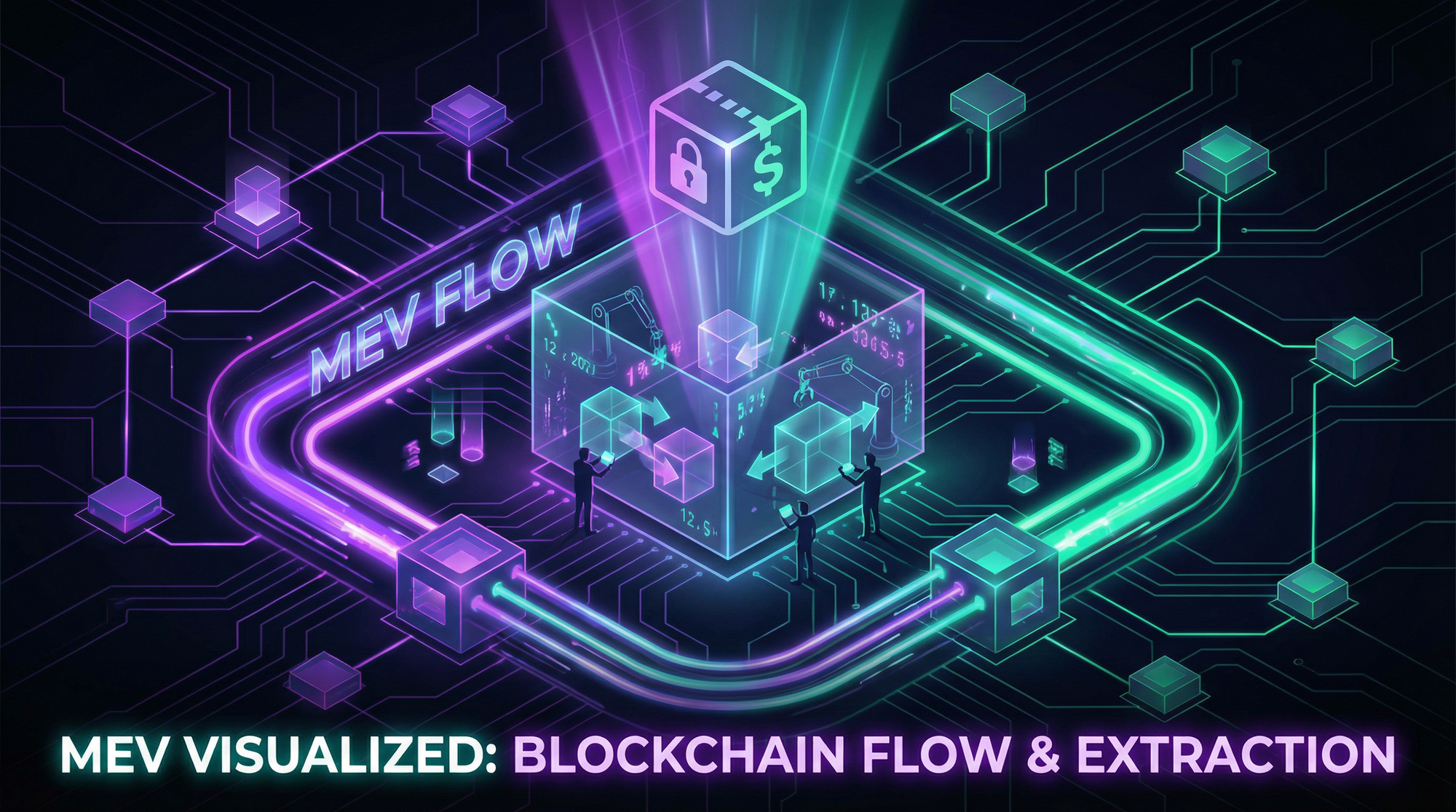
While traders chase memecoin pumps and fight over milliseconds with trading bots, there's a different gold rush happening on Solana—one that's far more lucrative and completely invisible to most users. It's called MEV (Maximal Extractable Value), and it's generating over $35 million annually for those who control the infrastructure.
Here's what caught my attention: one company—Jito Labs—has positioned itself to capture a dominant 94% of Solana's validator stake. That's not a typo. Nearly the entire network runs their MEV-optimized client, and they're earning millions by doing what used to cause network chaos.
What Is MEV and Why Does It Matter?
MEV is the profit validators and block builders can extract by reordering, including, or excluding transactions when creating blocks. Think of it like this: if you're building a block and you see someone about to make a huge trade that'll move the price, you can insert your own trades before and after theirs to capture profit.
On Solana, MEV opportunities come from three main sources:
- Arbitrage - When the same token has different prices across DEXs, bots buy low on one exchange and sell high on another
- Liquidations - Racing to liquidate undercollateralized lending positions and claim the liquidation rewards
- Sandwich attacks - Placing trades before and after a victim's transaction to profit from the price impact they create
- Liquidations - Racing to liquidate undercollateralized lending positions and claim the liquidation rewards
- Sandwich attacks - Placing trades before and after a victim's transaction to profit from the price impact they create
- Sandwich attacks - Placing trades before and after a victim's transaction to profit from the price impact they create
Before Jito, Solana's MEV landscape was absolute chaos. Bots would spam the network with thousands of redundant transactions, hoping one would land at the right moment. Research showed that over 60% of Solana's compute units were consumed by arbitrage bots, with a staggering 98% failure rate. The network was drowning in failed transactions.
How Jito Changed Everything
Jito Labs introduced a game-changing solution: Jito Bundles. Instead of flooding the network with spam, MEV searchers now submit bundles of up to 5 transactions that execute atomically—all or nothing. Each bundle includes a tip to the validator, and Jito runs an off-chain auction to select the most profitable bundles.
Think of it like replacing a screaming mob at a concert entrance with an organized VIP auction. The highest bidders get in, and everyone else's failed attempts don't clog up the venue.
The results speak for themselves:
- Blockspace utilization improved by 50%
- MEV now accounts for 13-15% of total staking rewards
- 94% of network stake now runs Jito-Solana client
- Jito raised $62 million in funding, including $50M in late 2025
- MEV now accounts for 13-15% of total staking rewards
- 94% of network stake now runs Jito-Solana client
- Jito raised $62 million in funding, including $50M in late 2025
- 94% of network stake now runs Jito-Solana client
- Jito raised $62 million in funding, including $50M in late 2025
- Jito raised $62 million in funding, including $50M in late 2025
Who Actually Profits From MEV?
Here's where it gets really interesting. MEV profits don't just disappear—they flow through a very specific hierarchy:
Validators capture the majority. Running the Jito client, validators received 50% of their total revenue from MEV tips in 2024. That's massive—it means MEV has become as important as inflation rewards for validator economics.
Stakers get their cut. Through JitoSOL (Jito's liquid staking token), regular SOL holders can earn MEV rewards without running infrastructure. It's genius—they've democratized MEV profits while still taking their 5% commission on tips.
MEV searchers compete for scraps. In a competitive auction, searchers bid away nearly all their profits to validators. They're doing the hard work of finding opportunities, but the auction structure ensures most value flows to infrastructure providers.
Jito Labs takes 5% of all MEV tips through their block engine. With $35M+ in annual MEV, that's over $1.75M in recurring revenue for providing the infrastructure—not bad for solving a network problem.
The Invisible Tax on Regular Users
Here's the part that bothers me: while institutional players are printing money from MEV, regular users are systematically overpaying. Recent research from BQ Brady revealed that low-activity wallets—regular traders like you and me—routinely overpay priority fees even when blocks aren't full.
Sophisticated actors—market makers running millions of transactions—optimize their fees to the penny. They know exactly what's needed to land a transaction. Meanwhile, normal users are paying far more than necessary, essentially donating profits to validators.
It's payment-for-order-flow dynamics emerging on Solana, similar to how Robinhood routes orders. The difference? In TradFi, this practice is at least disclosed. On Solana, it's happening invisibly in the background.
The Firedancer Wild Card
Jito's dominance isn't guaranteed forever. Jump Crypto's Firedancer client—a complete rewrite of Solana in C—promises dramatically higher throughput and lower latency. If Firedancer can match or exceed Jito's MEV capabilities while offering better performance, validators might switch.
But here's the thing: Jito isn't sitting still. They've already released a Firedancer setup guide and are preparing for integration. They understand that controlling MEV infrastructure matters more than which underlying client validators run.
Why This Matters for Solana's Future
Jito's success highlights a fundamental truth about blockchain economics: infrastructure-level control beats application-level innovation for extracting value. While DeFi protocols fight for users and volume, Jito quietly positioned itself as the toll booth that everyone must pass through.
For Solana as a whole, this is both good and bad. Good because Jito solved a real network problem and made MEV extraction more efficient. Bad because such concentrated control raises questions about decentralization and fairness. When one entity controls 94% of validators' MEV infrastructure, they effectively control a significant portion of network economics.
The institutional players are already paying attention. Sol Strategies and other large funds are increasingly staking with Jito-enabled validators to capture MEV yields. As traditional finance moves onto Solana, MEV infrastructure will only become more valuable.
The bottom line? While everyone's watching memecoin charts, the real money in Solana is being made at the infrastructure level. Jito proved that solving hard technical problems and positioning yourself at critical network chokepoints is far more profitable than chasing trading alpha. It's a reminder that in crypto, as in traditional finance, the house always wins—and Jito built themselves one hell of a casino.