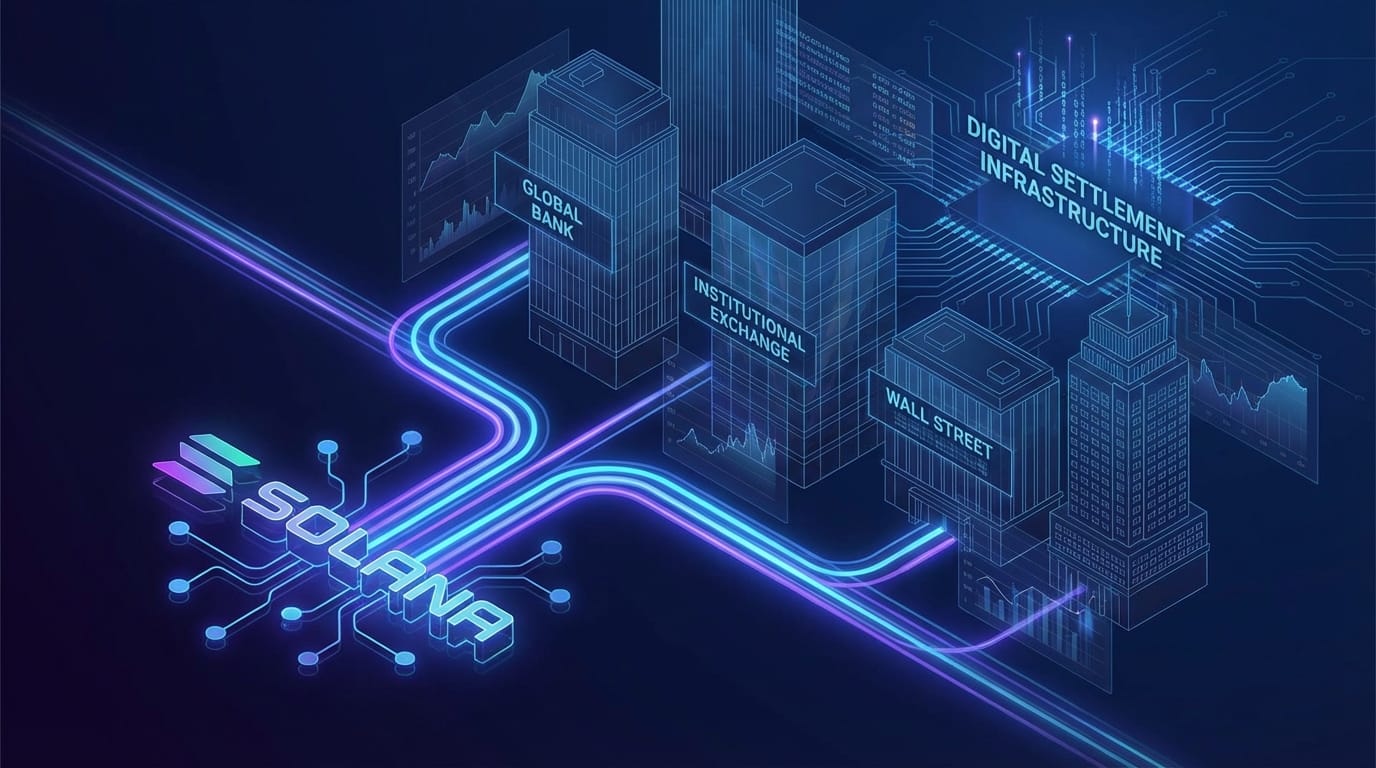
Solana is no longer just the blockchain for memecoins and NFT traders. In early 2026, something bigger is happening: major financial institutions are quietly adopting Solana as critical settlement infrastructure. Wyoming launched a state-backed stablecoin on Solana, Morgan Stanley filed for a Solana trust product, and Visa expanded USDC settlement to run on Solana rails. This isn't speculation—it's happening right now.
The Institutional Shift: From Skepticism to Adoption
For years, the narrative was clear: institutions won't touch Solana. Network outages, regulatory uncertainty, and the FTX collapse created a perception problem that seemed insurmountable. But 2026 is proving those assumptions wrong.
The key distinction emerging now is that institutions aren't necessarily betting on SOL as an investment asset—they're leveraging Solana as operational infrastructure. The difference matters. When Visa chose Solana for USDC settlement expansion, they weren't making a speculative bet. They were choosing the fastest, cheapest blockchain that could handle massive transaction volumes without breaking.
Wyoming's Bold Move: A State-Backed Stablecoin on Solana
Wyoming's launch of a state-backed stablecoin on Solana represents a watershed moment for blockchain adoption. This isn't a private company experimenting with crypto—it's a U.S. state government choosing Solana as the foundation for digital currency infrastructure.
The implications extend far beyond Wyoming. When government entities validate blockchain technology by building on it, they create regulatory precedents and operational blueprints that other states and institutions can follow. Wyoming evaluated multiple chains and chose Solana for its speed, cost efficiency, and proven ability to handle high-volume settlement.
Circle Injects Fresh Liquidity: $750M USDC Mint
Starting 2026 with momentum, Circle minted $750 million USDC on Solana in the first major stablecoin issuance of the year. This wasn't a routine mint—it marked the first time in 2026 that such significant liquidity entered the Solana ecosystem, instantly drawing attention from traders, developers, and institutional participants.
Large stablecoin mints typically signal upcoming trading activity, DeFi expansion, or institutional positioning. USDC serves as the primary settlement asset for trading, lending, and payments across Solana's ecosystem. When Circle deploys hundreds of millions in fresh liquidity, it reflects organic demand from exchanges, DeFi protocols, and large market participants—not speculative deployment.
Real-World Assets: Solana's $873M Tokenization Milestone
December 2025 data from RWA.xyz revealed that Solana's tokenized real-world asset value hit $873.3 million, up almost 10% for the month. RWA token holders on the network soared more than 18% to over 126,000. These aren't niche experiments—they're backed by institutional heavyweights.
BlackRock's USD Institutional Digital Liquidity Fund ($255.4 million market cap) and Ondo US Dollar Yield ($175.8 million) now operate on Solana. Tokenized stocks including Tesla xStock and Nvidia xStock have joined the ecosystem. Solana is positioned to become the world's third blockchain, after Ethereum and BNB Chain, to surpass $1 billion in tokenized RWAs.
Why Institutions Choose Solana for Settlement
The institutional case for Solana as settlement infrastructure comes down to three operational requirements:
- Speed: Solana processes transactions in seconds with fast finality. Financial institutions moving billions daily cannot tolerate 10-minute block times or network congestion.
- Cost: Transaction fees on Solana remain a fraction of a cent. When Visa settles millions of USDC transactions, cost efficiency becomes non-negotiable.
- Scalability: Solana's architecture can theoretically handle thousands of transactions per second without layer-2 complexity. Institutions want infrastructure that scales natively.
These aren't theoretical advantages—they're proven in production. Western Union selected Solana to build its next-generation stablecoin settlement platform, servicing over 150 million customers in more than 200 countries. This level of institutional trust demonstrates Solana's readiness for global-scale financial infrastructure.
The Regulatory Catalyst: What Happens if CLARITY Passes
Industry observers, including Bitwise, predict that if the U.S. passes the CLARITY Act in 2026, Solana could reach new all-time highs driven by massive growth in tokenization. Regulatory clarity removes one of the last major barriers preventing institutional capital from flowing into blockchain infrastructure.
The SEC's approval of six spot Solana ETFs in late 2025 has already attracted $765 million in inflows. This institutional interest validates Solana not just as a speculative asset, but as infrastructure worthy of traditional finance integration. If comprehensive crypto legislation passes, expect these inflows to accelerate dramatically.
Onchain Revenue Leadership: $110M in 30 Days
Solana isn't relying on memecoins for network income anymore. DeFiLlama data shows Solana led all blockchains with over $110 million in app revenue in the last 30 days—far outpacing competitors and almost doubling Ethereum's numbers.
This revenue comes from DeFi protocols, NFT marketplaces, payment applications, and tokenized asset platforms—all generating real economic activity. The diversity of revenue sources demonstrates ecosystem maturity and resilience beyond speculative trading.
What This Means for SOL Price Action
As of early January 2026, SOL trades around $125—well below its all-time high of $293. Compared to Bitcoin and Ethereum trading near their peaks, Solana appears undervalued relative to its infrastructure adoption and institutional momentum.
If the RWA and institutional settlement narratives continue strengthening, SOL has significant room to appreciate. The token serves as the gas and staking asset for the entire network—as transaction volumes increase with institutional adoption, demand for SOL inherently grows.
The Path Forward: Infrastructure Over Speculation
The transformation happening in early 2026 represents a fundamental shift in how institutions view Solana. The question is no longer whether Wall Street will embrace Solana—it's how deeply they'll integrate it into financial infrastructure.
Wyoming's stablecoin, Circle's liquidity injection, BlackRock's tokenized funds, Visa's settlement expansion, Western Union's platform—these aren't experiments. They're production deployments handling real money and real users at scale.
As Solana continues proving its reliability and institutions deepen their commitments, we're witnessing blockchain infrastructure finally cross the chasm from crypto-native to mainstream financial adoption. For Solana, 2026 isn't just another year—it's the year institutional settlement infrastructure became real.